
Between the Tarentaise and Maurienne valleys in the Savoie department. There, the Massif de la Vanoise is one of the most impactful mountain ranges in the French Alps.
In this guide, we’ll share practical information on the geography, weather, hikes, wildlife, and villages that make up the area, plus useful checklists to help you plan your trip.
The Vanoise Massif
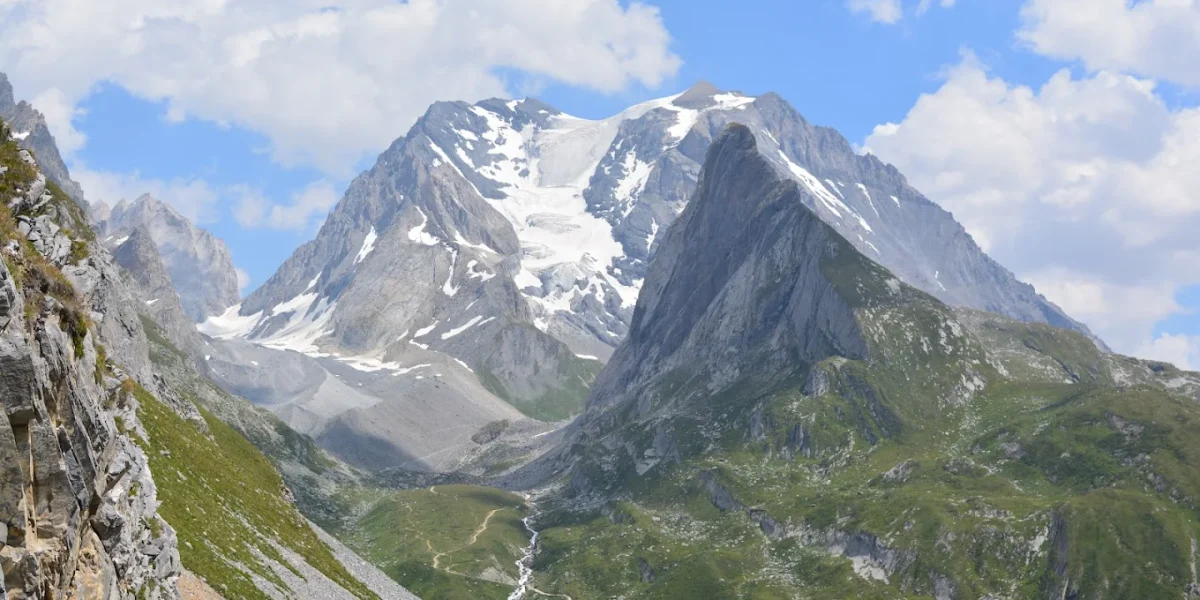
Le Massif de la Vanoise is the third-highest mountain range in France, after Mont Blanc and the Écrins. It belongs to the Graian Alps and sits entirely within the Savoie department. The Grande Casse, at 3,855 metres, is the highest summit.
The Vanoise National Park (Parc National de la Vanoise) was created in 1963, making it the first national park in France. It was set up largely to save the Alpine ibex from extinction after the species had been overhunted. The protected area covers around 53,000 hectares and shares a 14 km border with Italy’s Gran Paradiso National Park.
Interesting facts
- Location: Savoie department, between the Tarentaise and Maurienne valleys
- Highest summit: Grande Casse (3,855 m)
- Peaks above 3,000 m: 107
- National park area: approximately 53,000 hectares
- Year founded: 1963 (France’s first national park)
- Waymarked trails: over 500 km, with around 40 mountain refuges
- Plant species recorded: roughly 1,700, about a third of France’s flora, on less than 0.5% of the territory
Map and geography of the Massif de la Vanoise
If you look at a Massif de la Vanoise map, you’ll see the range along the Isère river to the north (Tarentaise valley) and the Arc river to the south (Maurienne valley). The Italian border is to the east, while the Belledonne and Lauzière Massifs lie to the west.
Roughly a quarter of the national park sits above 2,500 metres, and the range still holds significant glaciers, though they’ve shrunk dramatically in recent years.
Main access points
- Tarentaise (north): Moûtiers and Bourg-Saint-Maurice, reachable by TGV from Paris in around 5h30
- Maurienne (south): Modane, served by the A43 motorway and rail
- By air: The closest airports are Chambéry, Lyon-Saint Exupéry, and Geneva
Weather and climatic conditions
The weather Massif de la Vanoise decides whether you’re booking a ski week or planning a summer trek.
The range is shielded from the Atlantic systems by the Belledonne Massif and the Pre-Alps, which means you’ll expereince sunnier summers than other areas. Winters, on the other hand, are properly alpine, long, cold, and snowy, especially above 2,000 metres.
UV exposure is intense above
Must-do hikes and activities
With more than 500 km of paths, around 40 refuges, and two long-distance trails (the GR5 and GR55) crossing the range, the Massif de la Vanoise is a serious hiking destination.
You can walk a flat lakeside loop or a week-long high-altitude tour depending on your fitness level and experience.
Suggested hiking trails
Col de la Vanoise (2,517 m): the classic walk from Pralognan, passing under the cliffs of the Grande Casse
Lac des Vaches: the famous “stepping-stone” lake on the route to the Col
Tour des Glaciers de la Vanoise: a five- to seven-day hut-to-hut circuit
Lac de Tueda (Méribel-Mottaret): a gentle, family-friendly walk in a larch and Arolla pine reserve
Pointe de l’Observatoire: a strenuous day from Val-Cenis with panoramic views
A stage of the GR5 or GR55: a single day on one of the great Alpine traverses
Other activities beyond hiking
- Via ferrata around Pralognan, Aussois, and Champagny-en-Vanoise
- Climbing on the Aiguille de la Vanoise and the Épéna
- Mountaineering on the Grande Casse, Grande Motte, and Mont Pourri
- Mountain biking in the lower valleys and former pasture tracks
- Snowshoeing and ski touring in winter, especially around Lac de Tueda
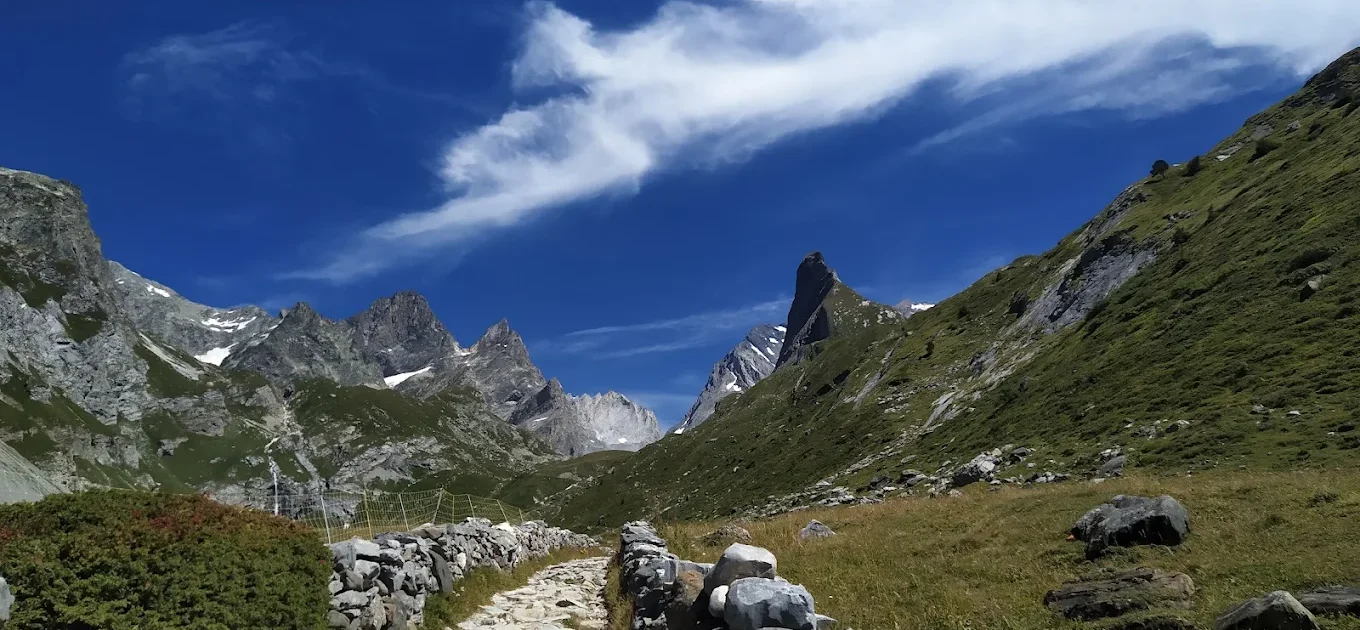
What vegetation and animals can you find in Vanoise National Park?
This is where Le Massif de la Vanoise really stands apart from other mountain ranges. The park has about 1,200 protected species and accounts for around 1,700 plant species.
Some common wildlife you may spot in the area include Alpine ibex. This is the very species the park was created to save back in 1963. Due to the rocky slopes alongside it, you’ll also often find chamois at dawn or dusk, when they come out to graze. From April through to September, Alpine marmots are easy to spot, while overhead, you can see golden eagles.
At higher altitudes, you might find black grouse, ptarmigan, mountain hare, and ermine, all of which change colour with the seasons to blend into the alpine terrain.
Plant life by altitude
- 800–1,500 m: beech and fir forests, hay meadows
- 1,500–2,000 m: rhododendron, bilberry, juniper, green alder
- 2,000–2,800 m: larch and Arolla pine, alpine pastures, gentian, edelweiss
- Above 2,800 m: cushion plants, lichens, glacier-edge species
Ski resorts and iconic villages
The Massif de la Vanoise is rimmed by some of the most famous ski areas in the world. The national park itself is car-free and undeveloped, but the perimeter includes Les 3 Vallées, Paradiski, and Espace Killy.
Les 3 Vallées links Courchevel, Méribel, Val Thorens, Les Menuires, Saint-Martin, Orelle, La Tania, and Brides-les-Bains into the world’s largest connected ski area, with around 600 km of pistes. At the top of that network is Val Thorens, which holds the title of Europe’s highest resort at 2,300 m and is usually open from late November right through to early May.
Further east, Tignes and Val-d’Isère form the Espace Killy, with roughly 300 km of pistes and peaking at 3,456 m. Just north of the Vanoise, La Plagne and Les Arcs make up Paradiski, where the double-decker Vanoise Express cable car links 425 km of slopes across two valleys.
On the quieter Maurienne side, Val Cenis and Valfréjus cater to families, with a more relaxed pace.
Plan your stay in the Vanoise with Alpvision résidences
The Massif de la Vanoise rewards you with serious mountain landscapes, whatever the season. You can ski above 3,000 metres in February, watch marmots from a meadow in July, and walk hut to hut through France’s first national park in between.
Ready to book your stay?
Alpvision résidences manages handpicked apartments and chalets in some of the best-placed villages around the Massif. Browse the full French Alps collection and book your stay near the Vanoise.


